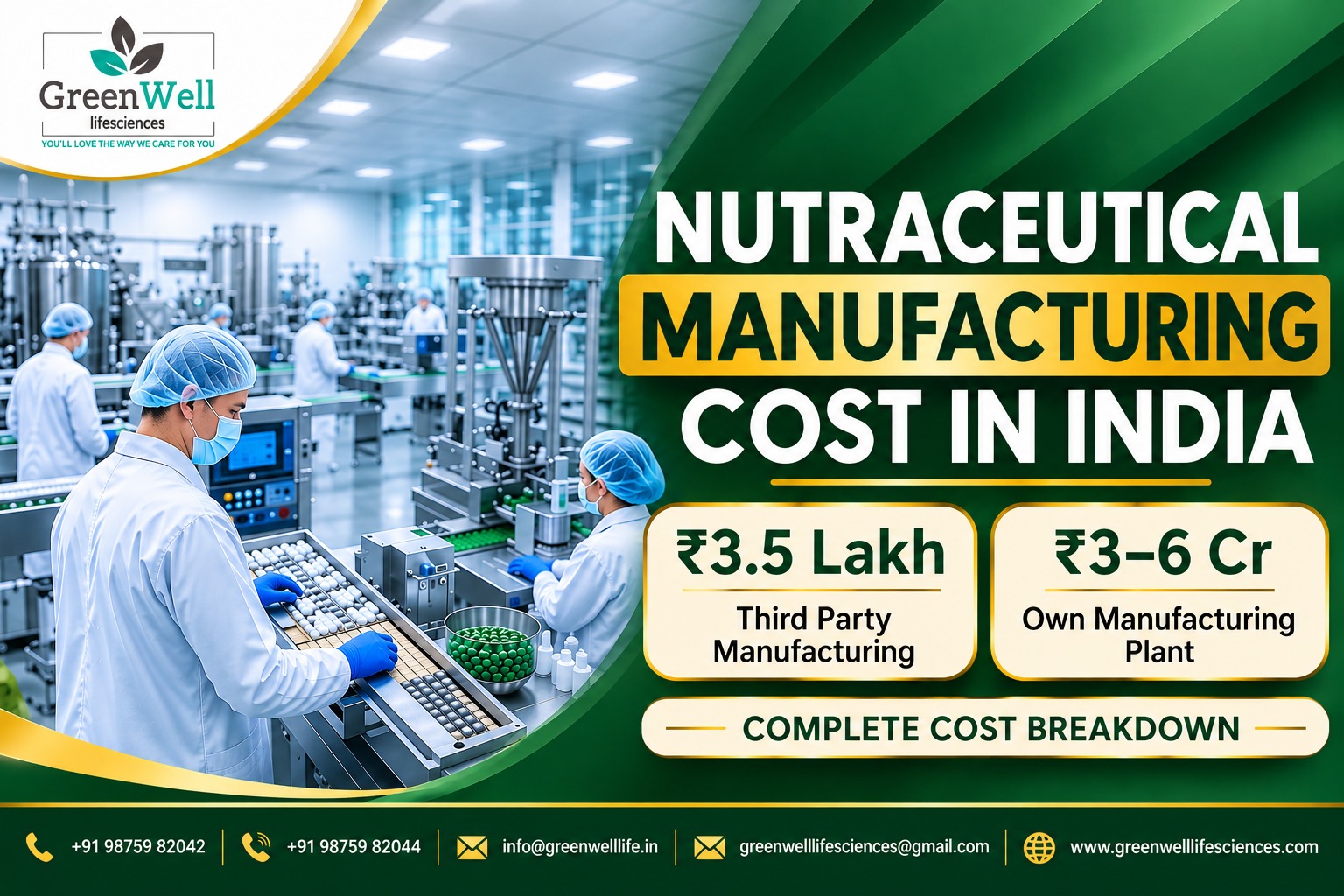
Key Takeaways:
- A brand built on contract manufacturing can launch for about ₹3.5 lakh to ₹6 lakh with a single product.
- A small plant of your own needs ₹3 crore to ₹6 crore. A medium plant with 200 tonnes a year of capacity needs ₹25 crore to ₹40 crore.
- A sensible launch budget gives about 40% to manufacturing, 40% to marketing and 20% to a reserve.
- Patented ingredients can cost 3 to 10 times more than generic herbal extracts.
- Most startups do better with third-party manufacturing until sales pass roughly 50,000 units a month.
The nutraceutical manufacturing cost in India depends first on one decision. You can hire a contract manufacturer, or you can build your own plant.
A brand launched through a contract manufacturing partner can start at ₹3.5 lakh to ₹6 lakh, while a small plant of your own needs ₹3 crore or more.
This guide explains each cost in plain terms, from raw materials to licences, so you can plan a budget that holds up.
Nutraceutical Manufacturing Cost in India: What Affects It
The Models: Own Factory vs. Third Party Manufacturing
Starting a nutraceutical business means choosing between two models. Each carries a very different price tag.
Contract (third-party) manufacturing needs little capital. A licensed manufacturer makes the product, and you own the brand. This suits direct-to-consumer brands that sell online.
Own manufacturing needs land, a building, machinery, clean rooms, laboratory equipment and a trained team. The capital is far higher, and the compliance work is heavier.
| Scenario | Investment range | Scope | Selling Platforms |
| Bootstrap launch (Self-funded) | ₹3.5 lakh to ₹6 lakh | 1 product, 2,500 to 5,000 units, ready formulation | Website and Instagram |
| Standard launch | ₹15 lakh to ₹25 lakh | 3 products, 5,000 units each, semi-custom blends | Website, Amazon, Flipkart |
| Seed-funded brand | ₹50 lakh to ₹1.5 crore | 5+ products, 10,000+ units each, custom formulations | Retail and e-commerce |
| Own small plant | ₹3 crore to ₹6 crore | Powder and tablet line | Brand and contract orders |
Type of Nutraceutical Products
Product format sets the base price. A softgel needs special encapsulation equipment, while a powder needs only blending and filling. The table shows indicative rates for contract manufacturing. Use it to estimate nutraceutical manufacturing cost per unit before you request quotes.
| Product type | Indicative manufacturing cost | What moves the price |
| Tablets and capsules | ₹120 to ₹280 per 60-count bottle | Active ingredients, coating, bottle type |
| Protein powders and nutritional supplements | ₹150 to ₹600 per 1 kg jar for wellness powders; whey concentrate can reach ₹1,100 to ₹1,500 per kg | Protein source, flavour, jar quality |
| Gummies and chewable supplements | ₹180 to ₹350 per 30-count jar | Ingredient mix, jar and sealing |
| Softgel capsules | ₹0.65 to ₹3.50 per capsule | Fill oil, active ingredient, order size |
| Herbal and plant-based supplements | No fixed range; branded extracts cost 3 to 10 times more than generic ones | Extract grade and standardisation |
| Liquid nutraceutical formulations | Quoted per batch and bottle; request a rate card | Bottle, filling line, stability needs |
Manufacturing Capacity and Production Volume
Capacity decides how much machinery, labour and building space you need.
- A small line for tablets and powders needs ₹3 crore to ₹6 crore in total. Machinery for such a line takes 22% to 26% of that sum, or ₹66 lakh to ₹1.56 crore.
- A medium facility with 200 tonnes a year of capacity costs ₹25 crore to ₹40 crore.
- Larger plants add more lines, more staff and bigger warehouses.
Batch size matters as much as plant size. Small-batch production, usually 2,500 to 5,000 units per product, keeps stock risk low and suits brands that are testing the market. The price per unit is higher because setup and cleaning time are spread across fewer units. Bulk production of 10,000 units or more per product lowers the nutraceutical manufacturing cost per unit and the packaging cost. It also ties up more cash in stock.
Location and Infrastructure Requirements
Factory location affects land price, labour rates, freight and access to suppliers.
Land, building and warehouse take 18% to 22% of capital cost, which is ₹54 lakh to ₹1.32 crore for a small unit.
Facility setup is the next big item.
Clean rooms and air handling systems with HEPA filters take 14% to 18% of capital cost, or ₹42 lakh to ₹1.08 crore. Storage sits within the land and building share, but it needs dry, temperature-controlled space for vitamins, probiotics and herbal extracts.
Utilities come last. A small unit should plan for roughly ₹1 lakh to ₹3 lakh a month for electricity, water and fuel. This is a planning estimate, so confirm it against local tariffs.
Detailed Breakdown of Nutraceutical Manufacturing Setup Costs
The table splits the capital cost of a small own-manufacturing unit using the typical share each item takes. Figures are shown for a ₹3 crore and a ₹6 crore project.
| Cost head | Share of capital cost | At ₹3 crore | At ₹6 crore |
| Land, building and warehouse | 18% to 22% | ₹54 lakh to ₹66 lakh | ₹1.08 crore to ₹1.32 crore |
| Machinery lines (tablet, capsule, liquid) | 22% to 26% | ₹66 lakh to ₹78 lakh | ₹1.32 crore to ₹1.56 crore |
| HVAC and clean rooms | 14% to 18% | ₹42 lakh to ₹54 lakh | ₹84 lakh to ₹1.08 crore |
| Quality control laboratory instruments | 8% to 10% | ₹24 lakh to ₹30 lakh | ₹48 lakh to ₹60 lakh |
| Utilities, licences, trial runs and opening stock (balance) | About 24% to 38% | ₹72 lakh to ₹1.14 crore | ₹1.44 crore to ₹2.28 crore |
Investment Required for Setting Up Your Own Manufacturing Unit
A small powder and tablet line needs ₹3 crore to ₹6 crore. A medium facility of 200 tonnes a year needs ₹25 crore to ₹40 crore. A large multi-format plant can reach ₹200 crore. You also carry staff, utilities, maintenance and compliance every month, even when orders are slow.
How Third-Party Nutraceutical Manufacturing Reduces Initial Investment
A contract manufacturer already owns the plant, machines, licences and staff.
You pay for each batch instead. This turns a crore-level capital cost into a lakh-level order. The third-party nutraceutical manufacturing cost usually covers the product and packaging, while formulation and sampling fees of ₹10,000 to ₹50,000 apply to custom work.
The table below breaks down the third-party nutraceutical manufacturing cost, from the per-unit rate to the one-time fees and the total launch budget.
| Cost item | Typical cost | When it applies |
| Tablets and capsules | ₹120 to ₹280 per 60-count bottle | Per unit, ready or semi-custom formulation |
| Softgel capsules | ₹0.65 to ₹3.50 per capsule | Per unit |
| Gummies | ₹180 to ₹350 per 30-count jar | Per unit |
| Protein and wellness powders | ₹150 to ₹600 per 1 kg jar (whey concentrate ₹1,100 to ₹1,500 per kg) | Per unit |
| Formulation, sampling and trial batches | ₹10,000 to ₹50,000 | One-time, custom formulations only |
| Packaging upgrade (amber or glass bottle, induction seal) | ₹5 to ₹25 per unit | Optional, on top of the base rate |
| FSSAI licence | ₹5,000 to ₹15,000 | One time |
| Company registration and GST setup | ₹15,000 to ₹40,000 | One time |
| Trademark registration | ₹9,000 per class | One time |
| Total for one product, 2,500 to 5,000 units | ₹3.5 lakh to ₹6 lakh | Bootstrap launch |
| Total for three products, 5,000 units each | ₹15 lakh to ₹25 lakh | Standard launch |
| Total for five or more products, 10,000+ units each | ₹50 lakh to ₹1.5 crore | Premium launch with custom formulations |
In short, manufacturing with a third party costs about ₹3.5 lakh to ₹6 lakh for a first single-product order. It rises to ₹15 lakh to ₹25 lakh for three products and ₹50 lakh to ₹1.5 crore for a larger custom range. Marketing is budgeted separately.
Which Business Model is Suitable for Startups?
Third-party manufacturing suits most startups. It keeps cash free for marketing and lets you test demand with one or two products. Many brands stay with contract partners until sales pass about 50,000 units a month. At that volume, the savings from owning a plant start to justify the capital and the staff.
| Cost factor | Own manufacturing | Third-party manufacturing |
| Factory setup | Required | Not required |
| Machinery | Required | Not required |
| Manufacturing staff | Required | Generally not required |
| Raw materials | Direct procurement | Usually managed by manufacturer |
| Quality testing | In-house or outsourced | Managed by manufacturer as agreed |
| Initial investment | Higher | Lower |
| Production control | Direct | Depends on manufacturer agreement |
How to Reduce Nutraceutical Product Manufacturing Cost Without Compromising Quality
Lower cost does not have to mean poorer quality. These six habits keep the nutraceutical manufacturing cost in India under control.
Start With a Limited Product Range
Begin with one or two high-margin products instead of a full catalogue. Every extra product adds its own minimum order, packaging, label and testing cost. A tight range also makes stock easier to manage.
Choose Cost-Effective Raw Material Suppliers
Compare quotes from several suppliers and ask for a certificate of analysis with each lot. Use generic extracts where your claims do not need a patented ingredient, since branded actives cost 3 to 10 times more. Cheaper must never mean untested.
Optimise Production Capacity
Run full batches, because half-filled batches waste machine time. If you build a plant, buy machines that match your first products and add lines as sales grow.
Use Suitable Packaging Materials
Match the pack to the product. An HDPE bottle may be enough for a dry tablet, while a light-sensitive formula may need amber glass with an induction seal, which adds ₹5 to ₹25 per unit. Standardise outer carton sizes across products to cut printing die costs.
Consider Third-Party Manufacturing
Use white-label or ready formulations to test the market before paying for custom research. Compare third-party nutraceutical manufacturing cost quotes from at least three licensed manufacturers, and check what each quote includes. The nutraceutical contract manufacturing cost is significantly lower than setting up your own factory.
Maintain Proper Inventory Management
Order stock in line with sales, not hope. Supplements have a shelf life, and unsold stock turns into a loss. Track reorder points and protect the 20% reserve for repeat orders.
How Much Profit Can You Make in the Nutraceutical Manufacturing Business?
Profit depends on the gap between your selling price and your total cost. The nutraceutical manufacturing cost in India is only one part of that cost. Distribution expenses, platform fees, advertising and returns make up the rest. Market demand decides how high you can price. A product with steady repeat purchases earns more over a year than a one-time purchase with the same margin.
Here is a simple illustration for one 60-count capsule bottle sold online by a brand that uses third-party manufacturing. The figures are illustrative, not guaranteed.
| Item | Amount per bottle |
| Selling price (excluding GST) | ₹650 |
| Manufacturing and packaging | ₹200 |
| Shipping and fulfilment | ₹70 |
| Payment fees and returns | ₹30 |
| Marketing cost per sale | ₹180 |
| Total cost | ₹480 |
| Profit per bottle | ₹170 (about 26%) |
On 5,000 bottles, the profit is ₹8.5 lakh on ₹32.5 lakh of sales. Marketing is also an important factor to consider. If the marketing cost per sale rises from ₹180 to ₹300, profit falls from ₹170 to ₹50 per bottle. This is why repeat customers matter so much.
Common Mistakes to Avoid When Estimating Nutraceutical Manufacturing Costs
- Overlooking working capital requirements. Stock, testing, freight and platform payment delays drain cash faster than expected, so keep the 20% reserve.
- Ignoring licensing and compliance expenses. FSSAI, company, GST, and trademark costs together can add ₹29,000 to ₹64,000, before any consultant fees.
- Investing in unnecessary machinery. Idle machines earn nothing and still need maintenance and space.
- Choosing low-quality raw materials to reduce costs. A failed test or a customer complaint costs far more than the saving.
- Overlooking packaging and distribution expenses. Packaging, freight and marketplace commissions can erase a thin margin.
- Starting with too many products. Each product multiplies minimum orders, testing and stock risk. A wrong nutraceutical production cost estimate in India usually begins here.
Starting Your Nutraceutical Brand with Greenwell Lifesciences
Greenwell Lifesciences, based in Derabassi, Mohali, offers third-party and private label nutraceutical manufacturing for new and growing brands. The company positions its range as budget-friendly, which suits founders who want to launch with a limited budget. Founders who want a clear nutraceutical manufacturing price list can request one through the website. Key points to know:
- The company lists 500+ ISO-WHO-GMP certified products and shows an FSSAI Central licence, GST registration and a WHO-GMP certificate among its certifications.
- It works in tablets, capsules, softgel capsules, syrups, protein powders, energy drinks, sachets and drops.
- Private label and customised manufacturing are available, and the company states that it accepts both low and high order quantities.
- Packaging options include blister packs, strips, bottles, sachets and vials.
- A free sample is offered at the first consultation, and the company states that contract orders usually take 45 to 60 business days.
- It lists 20+ R&D experts, 6+ years of experience, its own manufacturing facility and delivery across India.
The Conclusion: Navigating Nutraceutical Production Cost in India For Smarter Brand Launch
The nutraceutical manufacturing cost in India runs from a few lakh rupees for a single-product brand to hundreds of crores for a large plant. Most new founders do better starting small, with one or two products and a licensed contract manufacturer.
Keep 40% of the budget for marketing and 20% in reserve. Compare written quotes, check certificates and request samples before placing a large order. When the numbers are clear, the first launch becomes far less risky.
Frequently Asked Questions (FAQs)
1. What is the minimum investment required to start a nutraceutical business in India?
Ans. A brand that uses a contract manufacturer can start at about ₹3.5 lakh to ₹6 lakh for one product with 2,500 to 5,000 units. Setting up your own small plant needs ₹3 crore to ₹6 crore. Marketing and working capital come on top of the manufacturing cost.
2. Is a manufacturing license required for nutraceutical products in India?
Ans. Yes, if you manufacture the product yourself. An FSSAI licence is the usual starting point, and the exact type depends on the product category and production scale. If you hire a licensed contract manufacturer, the manufacturer holds the manufacturing licence. Confirm your own registration needs with a licensing consultant.
3. How much does nutraceutical manufacturing machinery cost?
Ans. Machinery takes about 22% to 26% of the capital cost of a plant. For a small unit costing ₹3 crore to ₹6 crore, that is roughly ₹66 lakh to ₹1.56 crore. Quality control instruments add another 8% to 10%, or ₹24 lakh to ₹60 lakh.
4. How long does it take to set up a nutraceutical manufacturing unit?
Ans. Many founders plan for 12 to 24 months to arrange land, building, approvals, machinery and validation. This is a planning estimate, and local approvals can change it. A brand launch through a contract manufacturer is much faster.
5. Can I get a nutraceutical manufacturing price list before ordering?
Ans. Yes. Most contract manufacturers share rates on request. Ask for a nutraceutical manufacturing price list that states the minimum order quantity, packaging, testing and delivery terms, so you can compare quotes fairly.
6. What nutraceutical manufacturing charges apply besides the per-unit price?
Ans. Common extras include formulation and sampling fees of ₹10,000 to ₹50,000, packaging upgrades of ₹5 to ₹25 per unit, printing plates and dies, lab testing and freight. List every line before you sign.
7. How much does trademark registration cost?
Ans. Trademark registration costs about ₹9,000 per class. Register your brand name early, because a name dispute after launch can force expensive repackaging.
8. Do branded ingredients raise the manufacturing cost?
Ans. Yes. Patented ingredients such as KSM-66 Ashwagandha or branded curcumin can raise raw material cost by 3 to 10 times compared with generic herbal extracts. They suit premium positioning, but they need a higher selling price to protect your margin.
9. When should I move from third-party to own manufacturing?
Ans. Many brands wait until sales pass about 50,000 units a month. At that volume, the savings from owning a plant begin to justify the capital, staff and compliance work. Until then, contract manufacturing keeps cash free for marketing.
10. Is private label cheaper than custom formulation?
Ans. Usually, yes. A ready formulation avoids research, sampling and stability testing fees. Custom work adds ₹10,000 to ₹50,000 in one-time fees and often needs larger orders. Use a ready formulation to test demand first.
11. How much does a medium-scale nutraceutical plant cost?
Ans. A medium facility with 200 tonnes a year of capacity costs about ₹25 crore to ₹40 crore. A large multi-format plant can reach ₹200 crore. Land, building, clean rooms and machinery take most of that capital.
12. How much does packaging add to the cost?
Ans. Packaging adds ₹5 to ₹25 per unit, depending on the material. HDPE bottles sit at the lower end, while amber or glass bottles with foil induction seals sit at the higher end. Labels, cartons and inserts add printing costs.