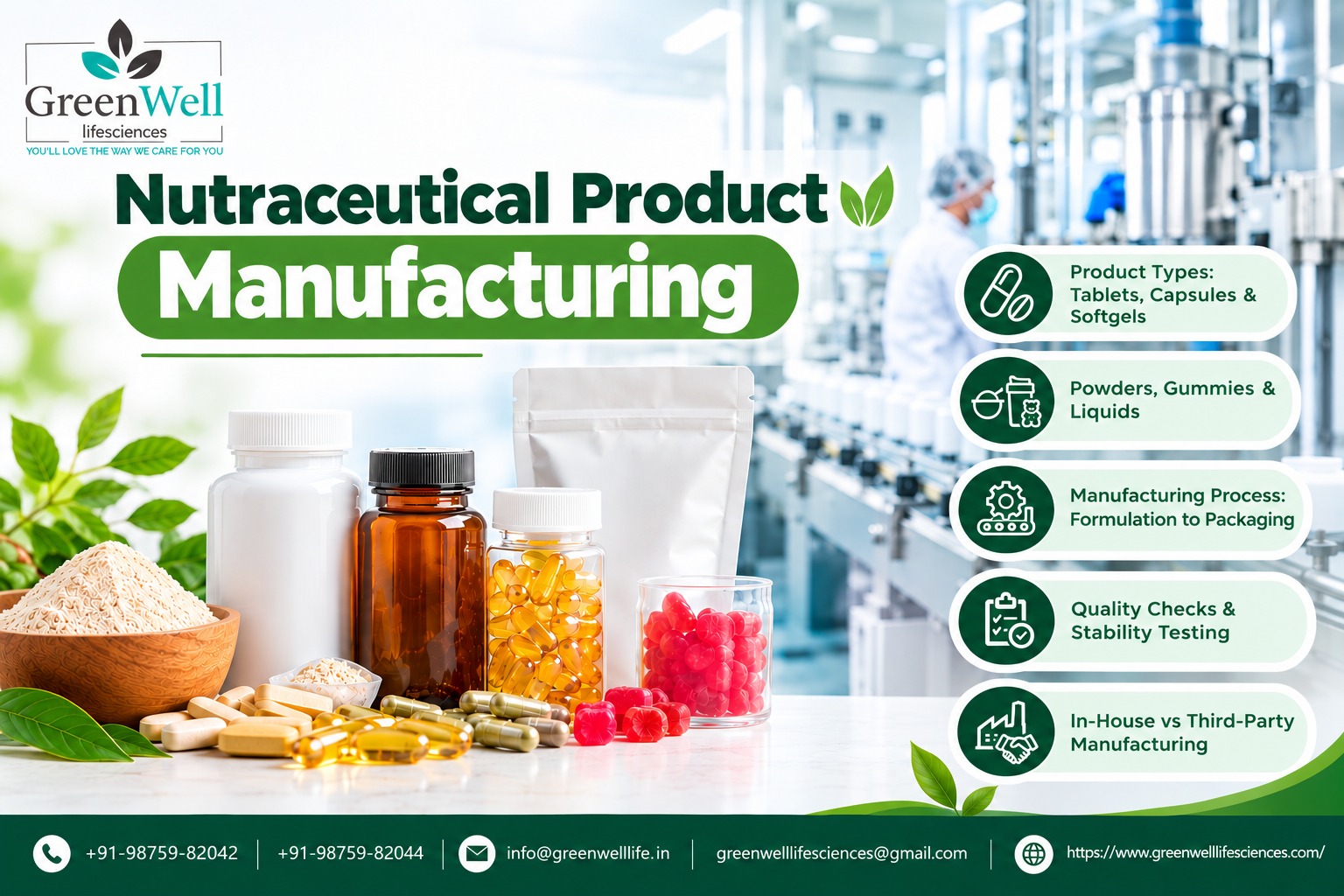
Manufacturing any health supplement is more than creating a good formula. Instead, it is a comprehensive process to turn raw materials into effective, market-ready products.
Nutraceutical product manufacturing covers sourcing, blending, testing, packing and compliance, and each step affects quality. This guide explains how it works, which products you can make, and how to pick a reliable partner in India, without the guesswork. Let’s get started.
What is Nutraceutical Product Manufacturing?
Nutraceutical product manufacturing is the production of health supplements, fortified food and dietary products that deliver functional medical or health benefits. A nutraceutical product manufacturer in India is required to follow GMP and FSSAI standards. It ensures the quality and efficiency of the products.
What Types of Nutraceutical Products Can Be Manufactured?
Manufacturers can produce a wide range of formats, from everyday vitamins to specialised herbal blends. The right choice depends on your target customer, ingredient stability and budget. The table below lists the main product types.
| Nutraceutical Product Type | Common Examples | Suitable Packaging Options | Factors Affecting MOQ |
| Tablets | Multivitamins, calcium, iron, zinc | Blister packs, strips, HDPE bottles | Tooling, batch size, ingredient cost |
| Capsules | Probiotics, herbal extracts, omega-3 blends | Bottles, blister packs | Shell type, fill weight, ingredient cost |
| Softgels | Omega-3, vitamin D3, vitamin E | Bottles, blister packs | Oil volume, shell material, machine batch size |
| Powders and Sachets | Protein, electrolytes, fibre blends | Sachets, tubs, pouches | Flavour range, blending batch size, pack format |
| Syrups and Liquids | Iron tonics, herbal syrups, vitamin drops | Glass or PET bottles, vials | Bottle size, preservatives, filling line capacity |
| Gummies | Vitamin C, biotin, multivitamin gummies | Jars, pouches | Mould size, moisture control, flavour choice |
| Functional Drinks | Energy drinks, electrolyte mixes | Bottles, cans, sachets | Formula type, shelf life, filling method |
Nutraceutical product manufacturing partners usually set MOQs by dosage form, so confirm these early before you finalise your range.
What is the Nutraceutical Manufacturing Process?
The nutraceutical manufacturing process follows a fixed order. Each stage has its own checks, so skipping one can affect safety, shelf life or compliance. Here are the key steps of nutraceutical product development.
Development and Formulations
The very first stage involves the formula creation, dosage forms and stability testing. It acts as the foundation of the final product.
Materials Sourced and Tested
Certificates of analysis are supplied for vitamins, extracts and excipients. Then the manufacturer tests for identity, purity and contamination. Only approved materials are sent for production, and every batch is protected from the start.
Mixing and Granulation
Specialised machinery blends dry powders or liquid ingredients into uniform batches. Granulation improves the flow and uniformity of the powder to ensure an accurate distribution of the dose between all finished units in the final production.
Drug Product Processing
Blended materials are transformed into the final formats. High-speed equipment is used under strict cleanroom conditions to compress powders into tablets, fill hollow gelatin or vegetarian capsules, or bottle liquid solutions.
Coating and Finishing
Tablets may get a film or sugar coating to mask taste, protect actives from moisture and improve appearance. Enteric coatings help acid-sensitive ingredients survive the stomach. Not every product needs this step.
Quality Checks in Process
At this stage, technicians check weight, hardness, disintegration time and fill accuracy at predetermined intervals. Identifying the “gaps” early prevents the whole batch and keeps your records ready for any audit.
Packaging
Once the products are manufactured and pass all quality measures, they are packed into bottles, blisters, pouches or sachets.
How to Choose the Right Dosage Form for Your Nutraceutical Product
Your dosage form should match your audience, your active ingredients and your price point. Think about who takes it, how often, and whether taste or swallowing is a concern.
1. Tablets
Tablets are suitable for high-volume, low-cost products like multivitamins and calcium. They are stable, cheap per dose and easy to store.
2. Capsules
Capsules hide bitter tastes and work well for herbal extracts and probiotics. Hard gelatin and vegetarian shells are both available. They cost a little more than tablets but offer a cleaner, easier swallow.
3. Softgels
Softgels are carriers of oils and fat-soluble actives such as omega-3, vitamin D and vitamin E. They are good absorbers and protect the ingredients from air. Production costs are higher, and the minimum order quantities are often larger.
4. Powders and Sachets
The powder format is chosen for protein, electrolytes and fibre blends where the dose is large.
5. Gummies
Gummies appeal to children and adults who dislike pills.
6. Liquids and Syrups
They absorb quickly but require preservatives, careful stability testing and strong bottles.
In-House vs. Third-Party Nutraceutical Manufacturing: Which Is Better for Your Business?
In-house manufacturing gives you control, while third-party manufacturing gives you speed and lower costs. Most new brands start with a partner. The table compares both options side by side.
| Comparison Factor | In-House Manufacturing | Third-Party Manufacturing |
| Setup Cost | Very high (land, machinery, utilities, staff) | Low, as you pay per batch |
| Time to Launch | Often 12 months or more | Usually a few months |
| Licences and Approvals | You apply for and maintain all of them | The manufacturer holds the plant licences |
| Technical Expertise | You must hire formulators and quality staff | Partner’s R&D and quality teams support you |
| Quality Control | Full direct control | Depends on the partner, so audit carefully |
| Flexibility | Complete freedom over products and schedules | Limited by the partner’s capacity and MOQs |
| Scalability | Needs fresh investment to grow | Easy to scale by increasing order sizes |
For most startups, outsourced nutraceutical product manufacturing removes risk and lets you focus on marketing and sales.
How to Choose the Right Nutraceutical Product Manufacturers in India
The right partner protects your brand, so check credentials before you check prices. Use the points below to compare nutraceutical product manufacturers in India and shortlist the nutraceutical supplement manufacturers worth visiting.
- Ask for valid FSSAI, GMP and ISO certificates, and check that they are current. A manufacturer with missing or expired licences puts your product and your reputation at risk.
- Visit the plant in Mohali, Baddi or wherever it is, or request a virtual audit. Check hygiene, equipment and batch records. A clean, organised facility usually means consistent quality.
- Write a comparison of minimum order quantities, lead times and payment terms. Low MOQs enable new brands to test the market, backed by reliable timelines. Keep your stock in stock.
- Request certificates of analysis on a batch-by-batch basis and third-party test reports. Good nutraceutical supplement manufacturers are not shy about sharing these and are transparent about the source of their raw materials.
- Check that the facility handles your formats, from tablets and softgels to gummies and powders. A multi-format nutraceutical product manufacturing partner lets you add products later without changing suppliers.
- Look for packaging, labelling and regulatory support. Good partners help with label claims, artwork compliance and documentation, which saves time when you apply for licences or sell online.
- Look at customer reviews and request references. If you have long-term clients, low rejection rates and quick responses to your queries, you have a reliable manufacturing partner.
How Can GreenWell Lifesciences Help with Your Nutraceutical Product Manufacturing Needs?
GreenWell Lifesciences, based in Derabassi, Mohali, makes nutraceutical product manufacturing simple for new and growing brands. It holds ISO and WHO-GMP certifications and an FSSAI Central licence, runs its own facility, and offers private labelling, custom formulations, flexible MOQs, ready-to-sell packaging and pan-India delivery. Share your idea, and its team will guide you from first sample to final dispatch.
Frequently Asked Questions
1. How is a nutraceutical product manufactured?
Ans. It is a commercial process of manufacturing, processing & packaging of health supplements and functional foods with quality ingredients and under stringent safety standards.
2. Why outsource to supplement manufacturers of nutraceuticals?
Ans. Outsourcing means less capital outlay on machinery, gets you to market faster, guarantees regulatory compliance and frees you up to focus on branding and growing sales.
3. What are the dosage forms available?
Ans. Common dosage forms are tablets, hard gelatin / vegetarian capsules, softgels, powders, oral liquids, syrups, effervescent and chewable gummies.
4. What is MOQ (Minimum Order Quantity)?
Ans. MOQs are the minimum quantity of units or batches a manufacturer is willing to produce per order. This varies by packaging and the dosage form.
5. How do manufacturers guarantee the purity and safety of ingredients?
Ans. Manufacturers perform heavy metal testing, microbial testing and testing of the raw materials for each finished batch and provide a Certificate of Analysis (COA).
6. What are the factors that affect the shelf life of a product?
Ans. Shelf life is determined by real-time and accelerated stability testing in which active ingredient potency, colour, moisture levels and microbial safety are monitored over time.
7. What is Private Labelling?
Ans. Private labelling means that the manufacturer makes a product for you under your own brand name, logo and packaging. You design the label; the partner does the production.
8. What are the manufacturing costs of nutraceutical products?
Ans. The cost will depend on the ingredients, dosage form, size of the batch, packaging and testing. Premium actives and softgels are more expensive than basic tablets. Get itemised quotes from two or three manufacturers so you can compare fairly.
9. Can I have a sample before I place a bulk order?
Ans. Yes, a lot of manufacturers will send you samples, and you should always ask for them. Check taste, texture, appearance, and packaging before releasing the entire batch.
10. How to know if a manufacturer is reputable?
Ans. Look for the latest FSSAI, GMP and ISO certificates, clear test reports and a clean facility. A good nutraceutical supplement maker will answer questions freely and will let you visit or audit the plant.
11. Why work with Greenwell Lifesciences?
Ans. Greenwell Lifesciences is a WHO-GMP and FSSAI-certified company manufacturing all types of nutraceuticals in all formats. They have a flexible MOQ and offer cost-effective third-party manufacturing services.